B2B influencer marketing and why it’s more crucial than ever for the sales cycle
Guy O'Brien is Founder at Custom Influence, a boutique London-based B2B influencer marketing agency that delivers global campaigns for the world’s largest brands. Guy launched Custom Influence in 2022 (following a successful agency exit), amidst the shift to remote and hybrid work environments. As experts in their field, The PR Network works with Guy and his team in partnership to build out dedicated B2B influencer programmes for clients.
Our managing director Eileen Boydell spoke with Guy to understand how B2B brands can make the most of influencer marketing and the opportunities it can offer to more effectively influence the sales cycle.
Eileen: Briefly tell me about your work and why B2B influencer marketing is becoming more important for brands
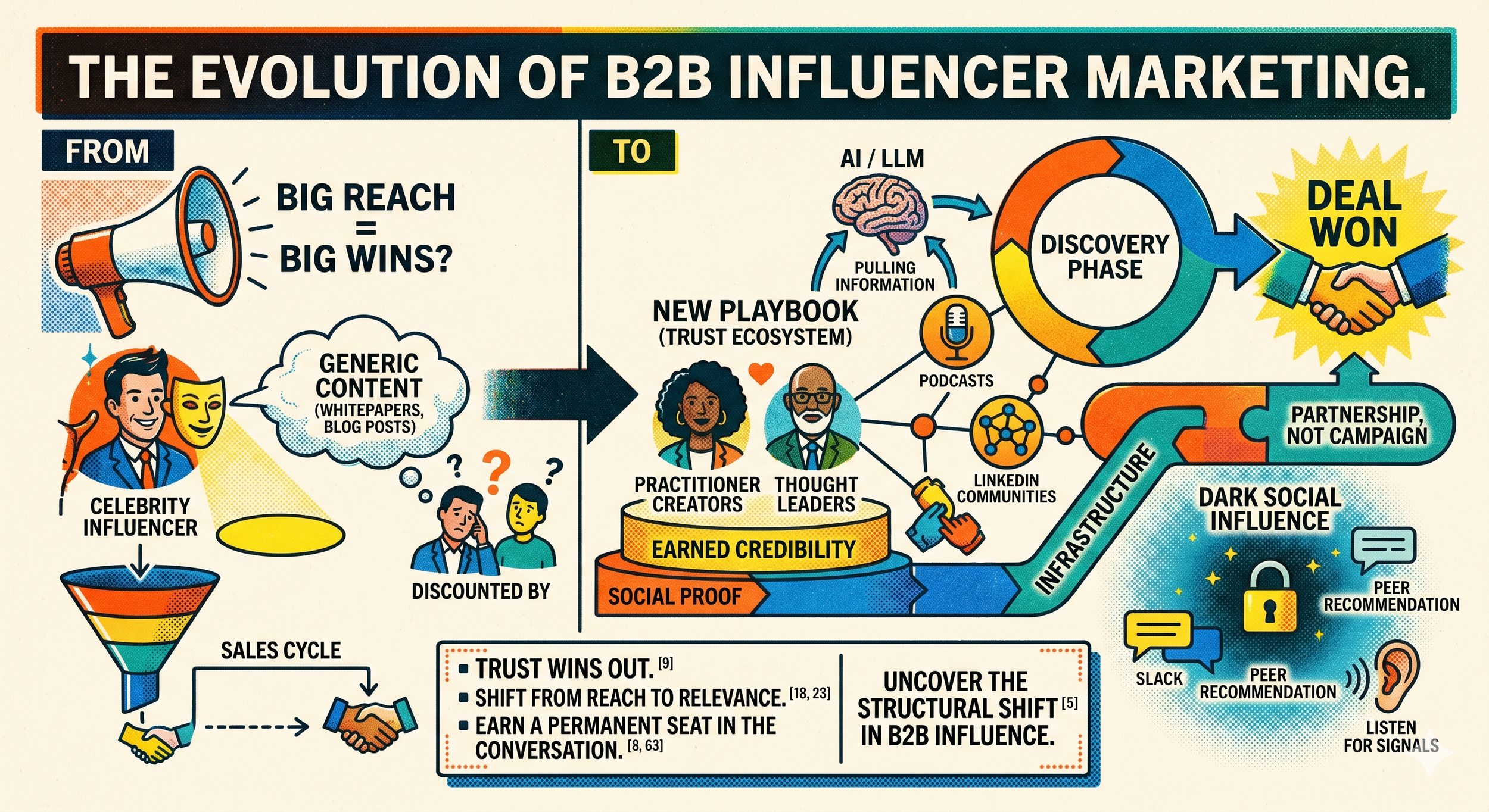
Guy: Kristen and I founded Custom Influence to solve a specific problem: B2B brands were either ignoring influencer marketing entirely, or borrowing the wrong playbook from B2C. Our background in paid media and traditional digital advertising gives us a good view on what REALLY works in B2B digital marketing. What we continually saw was that TRUST wins out in this space and that it was evolving from just being publishers and online news outlets buyers would turn to, but content creators and thought leaders who were building audiences on social media.
We work with leading technology and SaaS companies to build programmes around these practitioners who have genuine industry authority and who are regarded as trusted sources to the online audiences they serve.
On why it's growing in importance: buyers have fundamentally changed how they make decisions. They're doing the majority of their research before they ever speak to a salesperson or engage with a brand, and that research is happening through trusted voices. People they follow on LinkedIn, podcasts they listen to, communities they're part of. The brands that get in front of buyers during that discovery phase through credible third-party voices are winning deals before the sales conversation even starts. That's a structural shift, not a trend.
The rise of AI plays a big part in the research phase too, with LLMs pulling and citing info from LinkedIn and the leading voices that publish on the platform, ensuring that visibility and connection is maintained is crucial for brand discovery.
Eileen: Many in-house teams feel pressured to chase big-name industry celebrities for their campaigns, yet the data often shows that niche experts drive better conversion. How should marketing leaders re-educate stakeholders on relevance over reach?
Guy: The celebrity or big name influencer instinct is understandable. It feels like a safe, defensible choice internally but in most cases it is a hangover from consumer marketing in this space.
A 200,000-follower generalist tech commentator and a 15,000-follower cyber security practitioner with a highly engaged community are not comparable assets. The cyber security creator's audience is full of the exact buyers you're trying to influence, and those buyers trust them because they're one of them.
The way to win the internal argument is to shift the conversation from reach and impressions to audience composition and social proof. Show stakeholders who is actually in the audience and then map that against your ICP. That's a much more compelling story than a headline reach number. Being able to create quality content that acts as a signal to a buyer that you are being validated by a trusted source can be the difference between winning and losing a deal.
Eileen: How can brands use influencer partnerships to provide the human trust layer that AI can't replicate?
Guy: AI has essentially commoditised information. Any brand can now produce a technically accurate, well-structured whitepaper in minutes. The problem is buyers know this, and they're discounting generic content accordingly.
What AI cannot replicate is earned credibility. When a practitioner creator shares an opinion, their audience trusts it because they've watched that person be right about things before, disagree with vendors, and speak from real experience. That social proof is built over years and it's not transferable to a brand-published piece.
The opportunity for brands is to stop trying to own the content and instead generate credibility through genuine partnerships. That means giving creators real access. This could be to products, to data, to people inside the company and letting them form and share their own views. The brands that do this well treat their influencer relationships more like editorial partnership collaborations than paid media placements. It's a big difference and audiences know this.
Eileen: How do you help brands bridge the measurement gap between engagement and pipeline?
Guy: Anybody who tells you they have a clean, direct attribution model for B2B influencer marketing is at best oversimplifying it, or at worst lying.
Don't expect influencer marketing to look like paid search in your attribution model, because the role it plays is different. It's operating at the top of the funnel, building the familiarity and trust that makes your paid and sales efforts convert better downstream. The question is whether you can see that lift, not whether you can draw a straight line.
Dark social plays a big role in this space, with influence being delivered offline, in slack chats and in closed whatsapp groups. However, by collaborating with the people who hold the keys to these conversations you are gaining access and allowing your brand to be highlighted to the right people when the opportunity presents itself.
We track all front end, social platform actions as a rule but we feel it's the actions that count.
Eileen: How do you identify and partner with influencers who have authority in dark social spaces?
Guy: This is genuinely one of the biggest challenges but we spend time getting to know the influencer network we have built and have a clear understanding of who does what, how and why. Not all content creators are made equal!
The honest answer is that you can't discover dark social influence through a platform tool - by definition those conversations are closed. What you can do is work backwards from the signals. When you're doing customer interviews or sales discovery calls, pay attention to how people describe where they learned something. "I saw it in a Slack community," "someone in our peer network recommended it." If a specific name keeps coming up in those conversations, that's your dark social influencer.
The partnership model is also different. You're not running a sponsored post campaign. You're looking for ways to get genuinely useful information into the communities where that person has influence — whether that's contributing research they can share, co-authoring something, or simply building a real relationship that means they'll reference you organically when the topic comes up.
Eileen: Finally, is there a brand that you feel does B2B influencer marketing really well? What can other communications experts learn from this?
Guy: HubSpot is the example I keep coming back to. We worked with them on EMEA activations last year so had a ringside seat on how they operate.
What they've built isn't a traditional influencer programme, it's an ecosystem. They've invested time and effort in creating genuine value for a community of marketers and salespeople, and the creators who operate in that space naturally gravitate towards HubSpot content, certifications, and tools because it makes their own content better.
The lesson for other brands is that the best B2B influencer marketing doesn't feel like a campaign. It feels like infrastructure that creators want to be part of. HubSpot figured out that if you make influencers more credible and useful to their audience via benchmarked data, tools, and platforms you don't have to pay for every mention. You earn a permanent seat in the conversation.
Most brands think campaign by campaign. HubSpot thinks in ecosystems.
If you’re interested in how to effectively launch and manage a B2B influencer marketing programme to build authority, please contact eileen@thepr.network to discuss how we can help.